
Quick answer: Critical swim speed (CSS) is a practical estimate of the fastest sustainable aerobic swimming pace. Test it with rested, all-out 400-meter and 200-meter swims separated by full recovery. Calculate CSS pace per 100 meters as (400 time in seconds − 200 time in seconds) ÷ 2. Use the result as a benchmark for controlled threshold sets—not as a pace you must hit forever without fatigue.
Triathletes love a clean number. We also have a habit of turning a useful number into a tiny aquatic dictator. CSS works best as a repeatable benchmark paired with technique, perceived effort, and session context.
What is critical swim speed?
Critical swimming speed comes from the relationship between distance and time across hard swims. Early research described it as the slope of that relationship and found strong associations with aerobic-threshold measures and 400-meter performance (Wakayoshi et al., 1992). A companion study showed that pool-derived critical speed could serve as a practical index of endurance performance (Wakayoshi et al., 1992).
In plain English, CSS approximates the boundary between hard aerobic swimming you can organize into substantial work and faster swimming that burns through your limited above-threshold capacity quickly.
It is not identical to lactate threshold, race pace, or a promise that you can swim continuously at CSS forever. Protocol choice, fitness, technique, and fatigue all influence the estimate.
Why CSS is useful for triathletes
Triathletes often train without daily deck coaching or lactate testing. CSS needs only a measured pool, a clock, and two honest efforts. It can help you:
- set repeatable aerobic and threshold paces;
- detect meaningful progress without a maximal 1500-meter test;
- separate “comfortably steady” from “accidentally racing lane three”;
- build pacing discipline for Olympic-distance and long-course swimming;
- monitor technique when paired with stroke count and RPE.
Research in trained swimmers found that CSS derived from 200- and 400-meter tests was close to 30-minute swimming velocity, while also warning that the estimate can slightly overstate sustainable speed (Dekerle et al., 2002). Treat it as a training anchor, not an absolute physiological border.
How to perform the 200/400 CSS test
Before test day
Use the same pool length, preferably at a similar time of day, and avoid a hard bike or run beforehand. Record whether the pool is 25 meters, 25 yards, or 50 meters. Do not mix units.
Warm-up
Try:
- 400 easy swim;
- 4 × 50 as 25 drill/25 swim;
- 4 × 50 building from easy to strong;
- 4 × 25 fast but relaxed with generous recovery;
- 200 easy.
Adjust the volume to your experience. The goal is prepared, not pre-tired.
Test protocol
- Swim 400 meters as fast as you can pace evenly.
- Recover fully—usually 10–15 minutes of easy swimming and rest.
- Swim 200 meters all-out with controlled opening speed.
- Record both times to the second.
You can reverse the order, but use the same order when retesting. Consistency improves comparison.
How to calculate CSS
Use seconds:
CSS seconds per 100 m = (400 m time − 200 m time) ÷ 2
Example
- 400 m time: 6:40 = 400 seconds
- 200 m time: 3:10 = 190 seconds
- Difference: 210 seconds
- Divide by 2: 105 seconds
- CSS: 1:45 per 100 m
The underlying two-distance equation estimates the slope between the performances. Recent national-level swimmer research found the 200/400 protocol reliable for critical speed, though the related above-CSS distance estimate was much less reliable (Papoti et al., 2024).
Common testing mistakes
Starting the 400 like a 100
If the first 100 is heroic and the last 100 resembles a lifeguard drill, the test measures pacing failure. Aim for even splits or a slight negative split.
Doing the tests while fatigued
A hard long ride, strength session, or swim set the day before can depress both results. Retest under similar conditions.
Mixing yards and meters
A CSS calculated in a 25-yard pool is a yards-based pace. Convert deliberately rather than pretending the pool became international overnight.
Chasing the number while technique collapses
If stroke length shortens, alignment deteriorates, or breathing becomes chaotic, you are no longer rehearsing efficient race swimming. Pace is only useful while form remains serviceable.
CSS training zones without fake precision
Use these as starting points and adjust for rest interval, set length, technique, and current fatigue:
| Training purpose | Starting pace | Feel |
|---|---|---|
| Recovery / technique | CSS + 15–25 sec/100 | Relaxed, full control |
| Aerobic endurance | CSS + 8–15 sec/100 | Sustainable conversation-between-reps effort |
| Strong aerobic | CSS + 4–8 sec/100 | Focused but repeatable |
| Threshold / CSS | CSS to CSS + 3 sec/100 | Hard, controlled, consistent |
| Above threshold | Faster than CSS | Shorter work, more recovery |
These bands are coaching ranges, not laboratory facts. Your repeat distance matters. Swimming 20 × 100 at CSS with 15 seconds rest is not the same demand as 5 × 400 with 60 seconds rest. A 2024 study found longer repetitions at critical velocity produced higher lactate, heart rate, RPE, and greater stroke-length decline than shorter repetitions despite matched work-to-rest structure (Mitchell et al., 2024).
Three CSS workouts for triathletes
Workout 1: CSS introduction
- 600–1000 warm-up and drills
- 12 × 100 at CSS + 2–4 sec/100, 15–20 sec rest
- 4 × 50 smooth-fast, 25 sec rest
- 200 easy
Stop the main set if pace slips repeatedly or technique unravels.
Workout 2: Long-course strength
- 800 warm-up
- 3 rounds of:
- 3 × 200 at CSS + 3–5 sec/100, 20 sec rest
- 100 easy
- 6 × 50 sighting every 6–8 strokes, relaxed
- 200 easy
The goal is durable rhythm, not pool-deck theater.
Workout 3: Pace change for open water
- 700 warm-up
- 3 × 600 as:
- 100 at CSS
- 400 at CSS + 5–8 sec/100
- 100 at CSS or slightly faster
- 60–90 sec between 600s
- 200 easy
This rehearses a purposeful start, settled middle, and assertive finish without making the whole set anaerobic.
How CSS relates to open-water pace
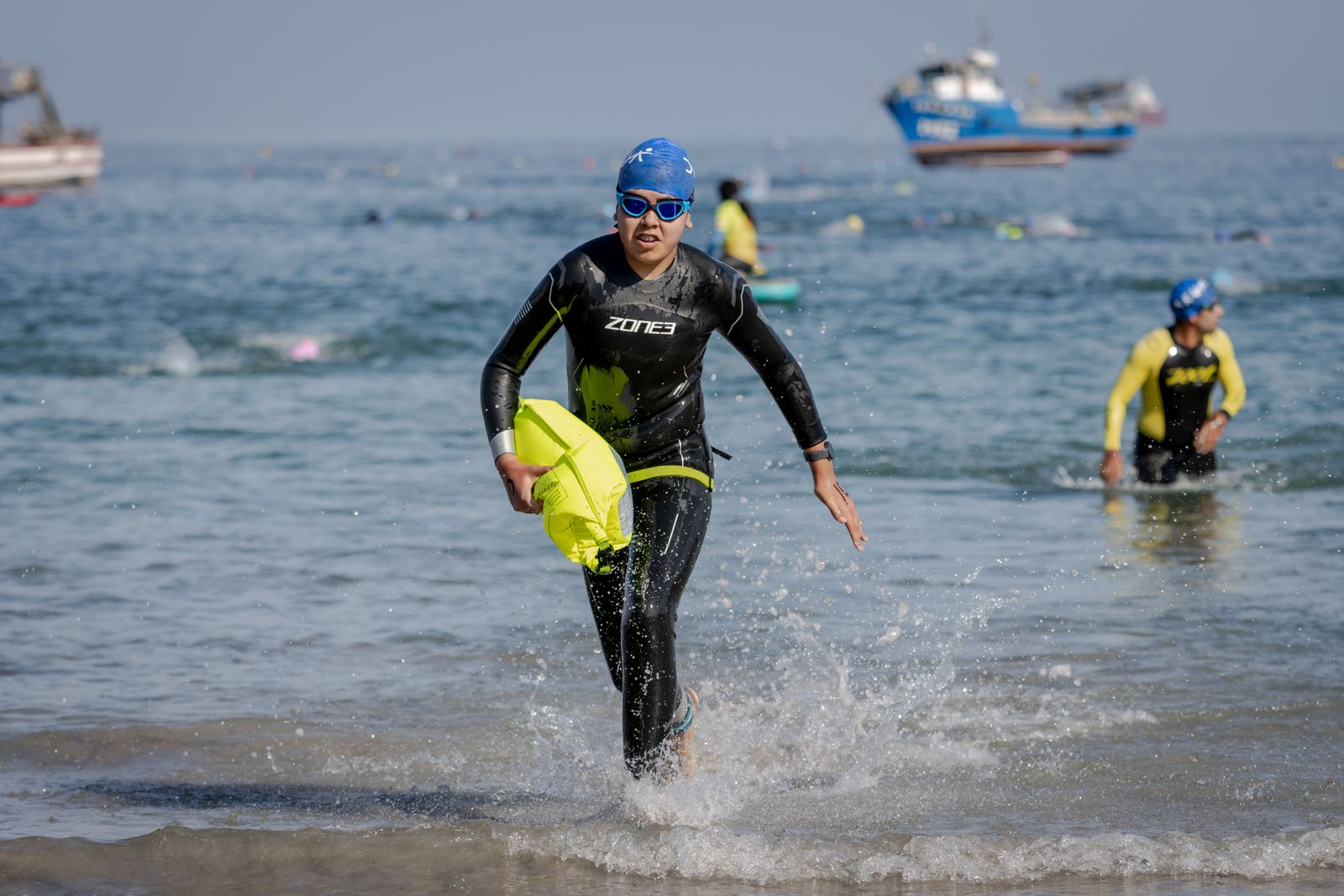
Pool CSS does not automatically equal open-water race pace. Wetsuit buoyancy, sighting, drafting, turns, current, chop, temperature, and pack dynamics change the result. Use CSS to anchor pool fitness, then validate race pace in supported open water.
For longer events, sustainable race pace is normally slower than pool CSS. For short triathlons, the first minutes may be faster because of positioning, but athletes still need to settle before early speed destroys technique.
How often should you retest?
Retest every six to eight weeks during a stable training block, or after a meaningful change in swim fitness. Test sooner only when you have a reason. Daily variability, pool setup, timing accuracy, and pacing can create small changes.
Keep the protocol constant and record:
- 200 and 400 times and splits;
- stroke count or stroke rate;
- RPE;
- pool length and water temperature if notable;
- prior-day training and sleep.
A faster CSS with stable or improved technique is stronger evidence of progress than a two-second gain bought with windmilling arms.
Coach’s bottom line
CSS gives triathletes a low-cost, repeatable swim benchmark. Test 400 and 200 meters honestly, calculate the pace, and use it to organize controlled training. Then watch technique, RPE, and consistency. The number should improve coaching decisions—not replace them.
FAQ
What is a good critical swim speed for a triathlete?
There is no universal good number. Compare CSS with your own history, race goals, pool length, and technique. Improvement and repeatability matter more than an arbitrary ranking.
Should I swim every threshold set exactly at CSS?
No. Repeat distance, recovery, fatigue, and technical goals change the appropriate pace. Many effective sets sit a few seconds per 100 slower than CSS.
Can I calculate CSS in yards?
Yes. Test 400 yards and 200 yards and the formula gives pace per 100 yards. Label it clearly and do not compare it directly with meter pace.
Is CSS the same as threshold pace?
It is a practical estimate related to aerobic endurance and threshold behavior, but it is not identical to every lactate, ventilatory, or maximal-steady-state definition.
How much rest should I take between the 400 and 200 tests?
Take enough recovery to produce a true second maximal effort—commonly 10–15 minutes with easy swimming. Use the same recovery when retesting.
Related AltaBrio guides
- Triathlon Training Zones
- Weekly Triathlon Training Plan
- Open Water Swim Skills and Strategy
- Gut Training for Triathletes
Sources
- Wakayoshi K, et al. Determination and validity of critical velocity as an index of swimming performance. Eur J Appl Physiol Occup Physiol. 1992.
- Wakayoshi K, et al. A simple method for determining critical speed as swimming fatigue threshold. Int J Sports Med. 1992.
- Dekerle J, et al. Validity and reliability of critical speed, critical stroke rate, and anaerobic capacity. Int J Sports Med. 2002.
- Dekerle J, et al. Physiological and stroke parameters to assess aerobic capacity in swimming. Int J Sports Physiol Perform. 2012.
- Papoti M, et al. Stroke-Specific Swimming Critical Speed Testing. J Hum Kinet. 2024.
- Mitchell LJG, et al. Biophysical analyses of interval training sets at critical swimming velocity. 2024.