
Quick answer: Prepare for a cold-water triathlon swim with several short, supervised exposures in similar water before race week; wear the legal wetsuit and thermal accessories allowed by your event; enter gradually when the venue permits; control the first minute instead of sprinting it; and exit immediately if breathing, coordination, or judgment deteriorates. A wetsuit helps, but it does not make every athlete thermally bulletproof.
Cold water is a blunt coach. It does not care what your pool CSS says, how expensive your wetsuit is, or whether your taper spreadsheet has tasteful color coding. The first task is not speed. It is keeping your airway, breathing, and decision-making under control.
This guide is for healthy adult age-group triathletes preparing for an organized event. It is not clearance for solo cold-water swimming. Athletes with heart, respiratory, neurological, or cold-related conditions—or a history of fainting—should discuss cold-water participation with an appropriate clinician.
What counts as cold-water triathlon swimming?
There is no single temperature at which water becomes “cold” for every athlete. Risk depends on water and air temperature, swim duration, body size and composition, acclimatization, health, pace, wetsuit fit, wind, waves, and the safety support around you.
For competition, rules provide useful boundaries. World Triathlon currently says wetsuits are mandatory for age-group races at 15.9°C (60.6°F) and below. For athletes through age 55–59, wetsuits are forbidden at 22°C (71.6°F) and above for swims up to 1,500 meters and at 24.6°C (76.3°F) and above for longer swims. For age groups 60–64 and older, the upper threshold is 24.6°C at all distances. The head referee announces the official ruling before the start (World Triathlon FAQ).
Those are event rules, not a promise that the water is comfortable or equally safe for everyone. Your local race may use different federation rules, modified distances, or stricter limits. Read the athlete guide and listen to the race briefing.
Why the first minute matters
Sudden skin cooling can trigger the cold-shock response: an involuntary gasp, rapid breathing, increased heart rate, and a surge in blood pressure. That combination raises the chance of inhaling water and makes calm stroke timing difficult.
A 2024 systematic review and meta-analysis found that repeated cold-water immersion reduced heart rate, breathing frequency, and ventilation responses, often after about four exposures, although individual response varied (Chalmers et al., 2024). Earlier experiments also found that anxiety can magnify the response or interfere with habituation (Barwood et al., 2017).
Practical translation: familiarity helps, but panic practice is not acclimation. Use controlled, supported exposures where you can enter and exit easily.
What a wetsuit can—and cannot—do
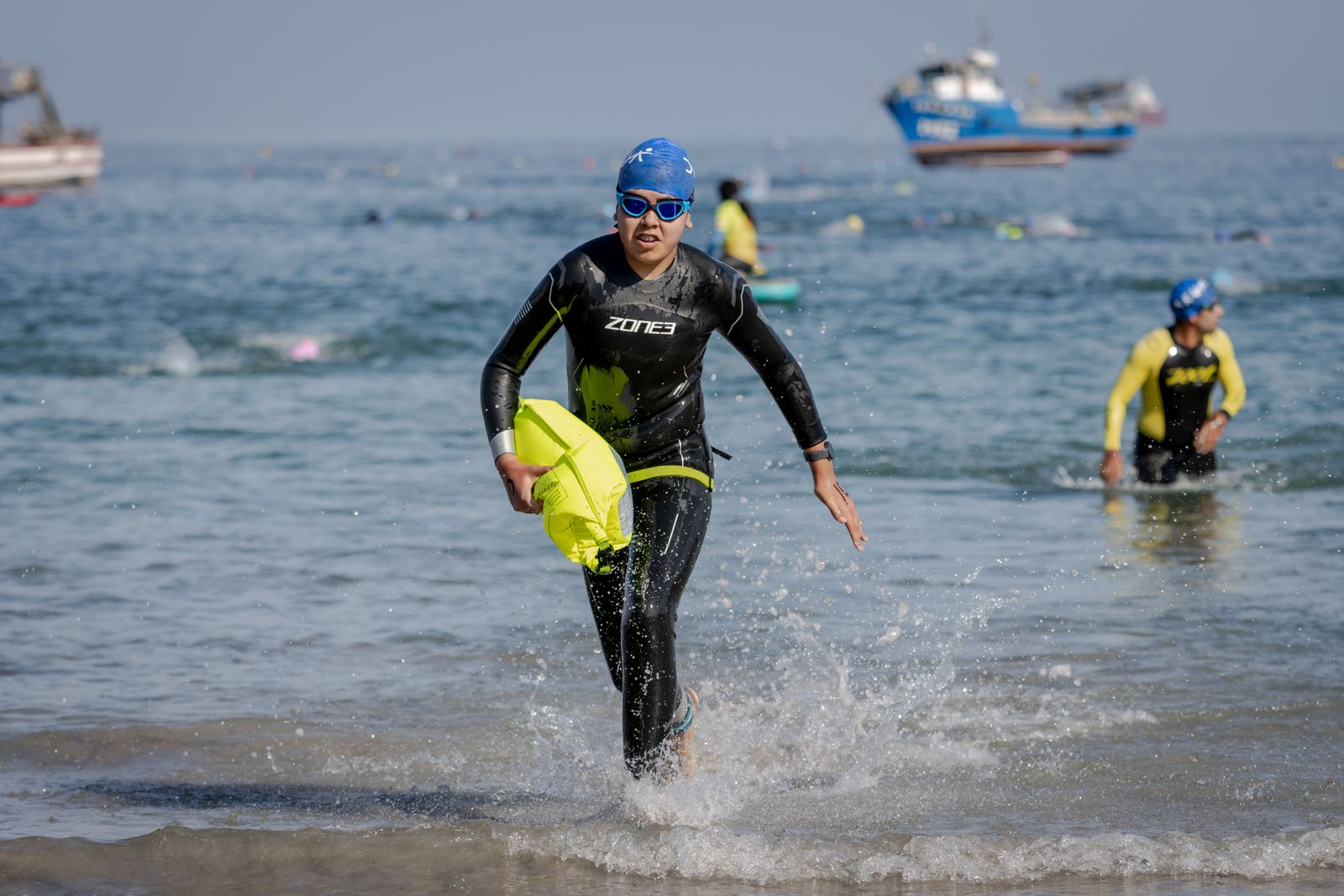
A properly fitted triathlon wetsuit improves buoyancy, reduces drag, and slows heat loss. Research in experienced triathletes has also found lower heart rate, perceived effort, and stroke count during wetsuit swimming compared with swimsuit swimming (Paradas et al., 2023).
But neoprene is insulation, not magic. In a 2025 cohort of 31 wetsuited open-water swimmers across 76 swims, deep-body temperature patterns varied substantially; water temperature and body habitus influenced the path toward thermal decompensation (Morton et al., 2025).
A 2026 laboratory study adds an important nuance. Twenty trained swimmers wearing competition-approved full-length wetsuits maintained core temperature down to a median critical water temperature of about 15.0°C, with body fat, metabolic heat production, and surface-area-to-mass ratio explaining part of the individual variation. The authors still recommended keeping the 16°C competition safety margin because real races include a wider athlete population and messier conditions than a controlled swim flume (Skutnik et al., 2026). That is a useful coaching lesson: a population average can inform rules, but it cannot tell you that your body will be fine for your race duration.
Triathlon-specific field data tell the same story. During a full-distance event in roughly 14.4–16.4°C water, one of 51 wetsuited athletes developed hypothermia; low body mass and a long swim time were identified as a concerning combination (Høiseth et al., 2021). Another study in 10°C water found highly individual temperature responses even with wetsuits, especially as swim duration increased (Melau et al., 2019).
Wetsuit fit checklist
- Pull the suit fully into the crotch and shoulders before closing the zipper.
- Make sure the neck seals without restricting breathing.
- Check that shoulder motion is free enough for relaxed recovery and catch.
- Practice sighting, drafting, and removal before race week.
- Use only event-legal thickness and accessories. World Triathlon limits wetsuits to 5 mm and does not allow coverage of the face, hands, or feet; socks are allowed when wetsuits are mandatory (World Triathlon FAQ).
If the suit makes breathing feel restricted on land, the lake is an expensive place to discover that “snug” became “medieval.”
A safer cold-water acclimation plan
The goal is to reduce surprise, rehearse breathing control, confirm equipment, and learn your personal warning signs. It is not to prove toughness.
Non-negotiable setup
- Swim at a supervised venue or with dedicated, capable support—not merely another athlete doing the same workout.
- Use a bright cap and event-appropriate visibility device where permitted.
- Know the water temperature, weather, exit points, and emergency plan.
- Have dry layers, a hat, a towel, and a warm drink ready.
- Never use alcohol or sedating medication before swimming.
- Do not hyperventilate or perform breath-hold drills before immersion.
Example progression
Exposure 1: Enter in a controlled location, keep the face out, and spend one to three minutes settling the breath. Exit while coordination and judgment are normal.
Exposure 2: Repeat the calm entry, then add several minutes of easy swimming close to the exit.
Exposures 3–4: Extend only if the prior sessions were uneventful. Rehearse race goggles, cap, wetsuit, and a short controlled start.
Later exposures: Build toward a portion of expected race duration, not necessarily the entire distance. Keep the effort aerobic enough to monitor hands, stroke control, and decision-making.
The meta-analysis supports habituation after repeated exposures, but it does not prescribe one universal dose. Water temperature, athlete response, and safety support matter more than completing a macho checklist.
The race-morning cold-water plan
1. Verify the actual conditions
Check the organizer’s measured water temperature, air temperature, swim distance, current, wind, and wetsuit ruling. Do not substitute last night’s app reading for the head referee’s announcement.
2. Warm up without sweating through your clothes
Use five to ten minutes of easy movement, arm swings, band work, and a few brief efforts. The aim is to feel ready, not damp and chilled while standing in a start corral.
If an in-water warm-up is permitted, use it to wet the face, seal the suit, clear the goggles, and rehearse exhalation. If no water warm-up is allowed, expect the first contact to feel sharper and choose a calmer start position.
3. Control immersion
Enter gradually when rules and venue design allow. Wet the face, exhale steadily, and wait for breathing to become controllable before swimming hard. If the start requires a jump or deep-water entry, stay conservative until the gasp and rapid-breathing phase settles.
4. Start at the speed of breathing control
Your first 100 meters should be governed by respiratory control, space, and stroke quality. A sprint start while you are gasping is a poor bargain. Build once you can exhale into the water, sight deliberately, and hold rhythm.
5. Choose clean water over heroic contact
Start wider or farther back if crowding increases anxiety. The fastest line on the map is not the fastest line if it comes with elbows, swallowed water, and a panicked U-turn.
Know the stop signals
Exit and seek assistance if you develop:
- breathing that remains uncontrolled;
- chest pain, faintness, confusion, or unusual palpitations;
- loss of coordinated stroke or inability to sight normally;
- rapidly worsening hand function;
- slurred speech or unusual behavior noticed by others;
- overwhelming panic that does not settle.
Shivering alone does not measure core temperature, and feeling “fine” is not a reliable safety instrument. Cold can degrade coordination and judgment before an athlete recognizes the decline.
After the swim: transition and rewarming
Cold problems do not necessarily stop at the timing mat. Core temperature can continue changing after exit, and a fumbling athlete can lose more time—and safety—than a calm athlete who dresses efficiently.
For training, remove wet gear, dry off, add layers and a hat, and rewarm gradually in shelter. For racing, practice a cold-weather T1:
- place a towel where rules permit;
- use simple gloves or layers you can manage with reduced dexterity;
- favor a controlled mount over a frantic one;
- tell medical staff about confusion, severe shivering, chest symptoms, or coordination loss.
Do not drive while cognitively or physically impaired after a cold swim.
A one-week race checklist
Seven to four days out
- Confirm event rules and likely conditions.
- Complete your final short supervised cold-water exposure.
- Inspect the wetsuit for fit, tears, zipper function, and neck chafing.
Three to one days out
- Avoid last-minute long cold swims.
- Pack two caps if allowed, anti-chafe, goggles with an appropriate lens, dry layers, and a warm post-race kit.
- Review start position, warm-up access, exit route, and emergency signals.
Race morning
- Listen for the official temperature and wetsuit ruling.
- Eat and hydrate normally; cold does not cancel fueling needs.
- Warm up, manage the first minute, and make finishing safely the first split of the day.
Coach’s bottom line
Cold-water triathlon swimming rewards preparation more than bravado. Repeated supported exposure can reduce the surprise of cold shock. A legal, well-fitted wetsuit can improve insulation and swimming economy. Neither replaces sensible limits, close support, or the willingness to stop.
Train the first minute, not just the first 100 meters.
FAQ
How many cold-water swims do I need before a triathlon?
Research suggests cold-shock habituation often appears after roughly four repeated exposures, but there is no universal prescription. Start with short, supervised sessions and progress only when breathing, coordination, and rewarming are normal.
Is a wetsuit enough to prevent hypothermia?
No. Wetsuits reduce heat loss but do not eliminate cold risk. Water temperature, swim duration, body characteristics, fit, pace, and individual response all matter.
What water temperature makes wetsuits mandatory in a triathlon?
Under current World Triathlon age-group rules, wetsuits are mandatory at 15.9°C (60.6°F) and below. Other organizers may use different rules, so check the athlete guide and race-day announcement.
Should I sprint the start to warm up?
Not while breathing is uncontrolled. Settle the cold-shock response, establish exhalation and stroke rhythm, then build effort. A panicked sprint increases risk and usually wastes speed.
Can I acclimate with cold showers?
Cold showers may reduce the surprise of skin cooling, but they do not reproduce face immersion, horizontal swimming, waves, wetsuit fit, or open-water decision-making. They are not a substitute for supervised venue-specific practice.
Related AltaBrio guides
- Open-Water Swim Safety for Triathletes
- Open Water Swim Skills and Strategy
- Triathlon Wetsuits: How to Choose the Best One for Your Swim
- Triathlon Training Zones
Sources
- World Triathlon. Triathlon FAQs: wetsuit-use rules. Accessed October 21, 2026.
- Chalmers S, et al. Habituation of the cold shock response: A systematic review and meta-analysis. J Therm Biol. 2024.
- Morton WJ, et al. Thermal physiology of open water wetsuited swimming: A cohort study. Temperature (Austin). 2025.
- Høiseth LØ, et al. Core Temperature during Cold-Water Triathlon Swimming. Sports (Basel). 2021.
- Melau J, et al. Core Temperature in Triathletes during Swimming with Wetsuit in 10 °C Cold Water. Sports (Basel). 2019.
- Barwood MJ, et al. Habituation of the cold shock response is inhibited by repeated anxiety. Physiol Behav. 2017.
- Croft JL, et al. Responses to sudden cold-water immersion in inexperienced swimmers following training. Aviat Space Environ Med. 2013.
- Tipton MJ, et al. Scientific rationale for changing lower water temperature limits for triathlon racing. Br J Sports Med. 2018.
- Paradas M, et al. The Effects of a Wetsuit on Biomechanical, Physiological, and Perceptual Variables in Experienced Triathletes. 2023.
- Skutnik BC, et al. Safe cold-water thresholds while wearing wetsuits approved for open water swimming competitions. J Appl Physiol. 2026.